Have you ever tracked your calories? Whether you have tried it, considered it, or used this practice intermittently, it comes with benefits and drawbacks. Earlier this year, we explored whether tracking your calories is a smart move. For those of you who have done any form of food logging (an app, a diary, a piece of paper, photos, etc.), it can become very involved. From weighing food and using various units of measurement, to chasing a target number and restricting yourself to meet short-term goals. But what if there was a middle ground? A way to stay on track with portions, without becoming tracking obsessed? Well, there is. And it comes back to all the power you have, right there in your own hands.
(Short on time? Click here for The Bottom Line)
As I have always said, awareness is the first step for any form of behaviour change. One of the most simple and straightforward approaches to tracking and portions, is a concept called, “The Zimbabwe Hand Jive”.
Invented by Dr. Kazzim Mawji in 1993, it was originally created to help people with Diabetes have an easier time understanding and practicing using healthy portion sizes. It has since been used globally for decades to help you have a quick reference for servings and portions, that is literally right at your fingertips.
https://www.umassmed.edu/dcoe/diabetes-education/nutrition/zimbabwe-hand-jive/
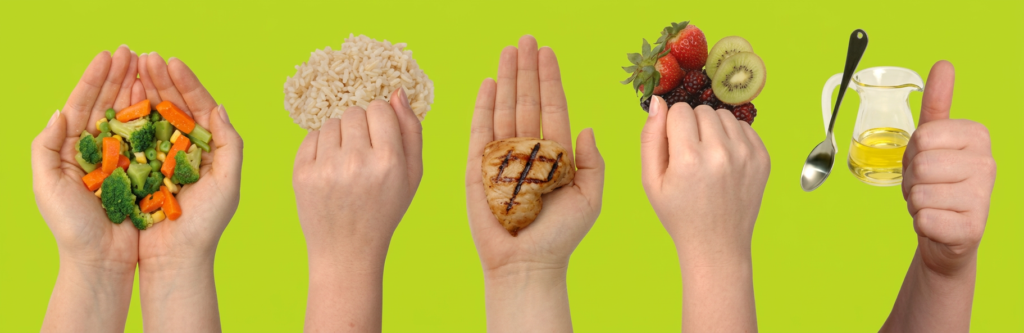
The easiest way to understand this is with the help of the above image. Let’s go through each hand shape and corresponding food portion together:
- Both hands open/cupped is for non-starchy vegetables. Eat as many of these veggies as you can literally fit into your two open hands.
- Your closed fist is for a portion of grains and starches (carbohydrates). Remember to choose healthy whole grains as much as possible, rather than refined fibre-stripped carbs.
- The palm of your hand represents a portion of protein. You may apply this to both animal, plant, or supplement sources of protein rich foods. Remember to consider the thickness of your palm as well.
- Your thumb is for a portion of fats. This is the same as approximately 1 tablespoon. I understand that feels like a small amount, but the calorie density may shock you.
I love using your hands as a reference for portions, because they are always with you, and it is still tailored to you and your body’s needs. Two more important parts to consider for the hand portion guide above:
- A closed fist can also be used to measure 1 serving of fruit. Note this is separate to your closed fist portion of other carbohydrates as mentioned above.
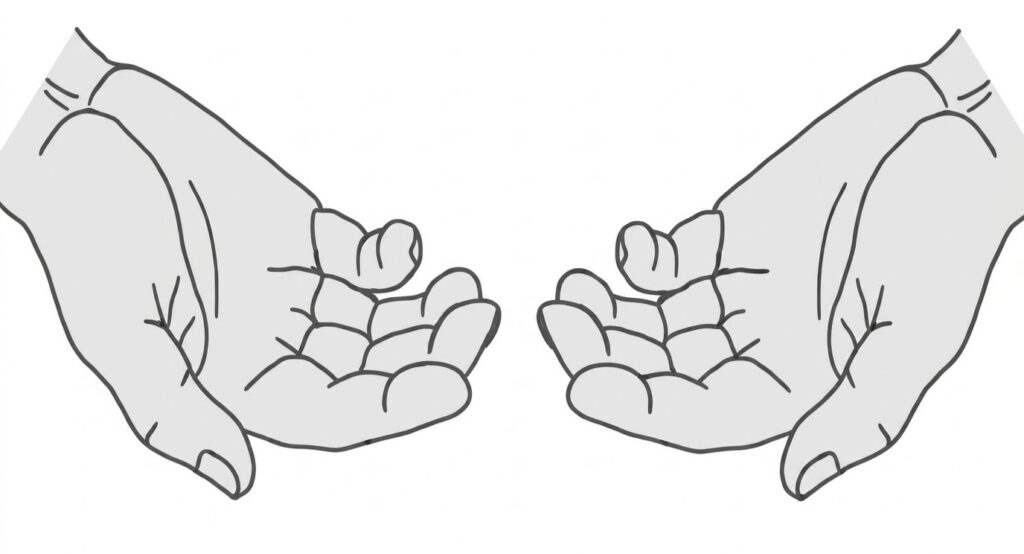
- You see two cupped hands in the image above. For non-starchy vegetables, I prefer the open hands approach where you turn your hands in towards each other, fingertips touching, and palms still open and facing up. As if you are carrying firewood. This helps you eat even more non-starchy vegetables, which I believe we cannot eat too much of! Here is an image of what I mean:
Using these portion guides is powerful because it can instantly create a well-balanced meal for you, anytime, anywhere. I also love the hands in particular because they are always with you and reduce the need or pressure for utensils, a food scale, a diary, or an app. This way, you can quickly determine servings and portions for a combination of vegetables, carbohydrates, fats, and proteins, without feeling as paralyzed.
When it comes to managing your Obesity, Diabetes, Heart Disease, or other chronic diseases, balanced portions of the right macronutrients matter. The source of your calories is also important as well, because not all calories are created quite the same. Both the type and amount of food you eat matters when it comes to health.
Bookmark this post and stay tuned for next week, where we will go through examples of food types for each of the hand portions which can help you make your own reference list, or help you visualize examples of foods that fit into your new hands-based serving sizes. Plus some bonus notes and tips on other strategies to pair the hand jive with!
Until then, give the Zimbabwe Hand Jive a try. At the very least, use at least one of the hand portion guides for one category of food and get used to that on your plate at every meal. I’d suggest prioritizing the volume of non-starchy veggies first! You got this.
As always, chase progress, not perfection.
I believe in you,
Dr. Khimji
This Week’s Challenge
Try out the Zimbabwe Hand Jive technique for at least 3 meals this week! (For an even more simple starting point, practice mastering one hand shape and corresponding food group first.)
The Bottom Line
Tracking calories and logging food can be cumbersome and often gets in the way of living life. At the same time, your awareness around what you eat and your portions is essential for better health. Where’s the balance? Consider the Zimbabwe Hand Jive! A free, useful, personalized reference guide to help you navigate portions and food estimations. First used for Diabetes patients, invented by Dr. Kazzim Mawji in 1993, this is a powerful example of how your health can literally be in your hands. Look at the photos in the post above or imagine your hands in various positions. Both of your hands open and cupped will fit a portion of non-starchy vegetables. A closed fist is a portion of grains and starches (carbohydrates), and can also be used to estimate 1 serving size of fruit. The palm of your hand is a portion of protein. Your thumb is a portion of fats. Using this strategy can take the pressure off, while still helping you get a balanced meal in, whether you are at home, out, or elsewhere!