
Dr. Khimji hosted Calgary’s 17th Walk With A Doc this past weekend, you can watch the health talk on Reading Food Labels here:
Imagine you are at the grocery store buying bread. You may have learned that eating more whole grains brings more health benefits, so you are trying to make a better choice compared to what you previously, automatically, tend to grab off the shelf. How do you go about this? Do you compare the front package of two loaves? Do you consider cost or unit price? Do you review the ingredient list? Are you checking for calories? Or protein? Fibre perhaps? These are all valid places to focus. But even with the best intentions and attempted due diligence, we may not be seeing the whole picture when it comes to nutrition.
(Short on time? Click here for The Bottom Line)
How you go about deciding whether a food item is the right choice for you is critical for your health. Having a consistent approach to follow each time makes this easier. Yes, there is a learning curve and it may slow you down at first, but once you practice enough, you’ll find your groove. And you’ll have a much better sense of how to determine a healthier choice between two similar products.
Enter food labels. Food labels are found on packaging and provide information about that food item. Food labels make it more convenient for you to compare foods from the same category to make smarter, healthier choices. On food labels, are 3 places you can find nutritional information:
- Nutrition Claims and Health Claims
- Ingredient List
- Nutrition Facts Table
We’re going to focus on how to read and better understand the Nutrition Facts Table. In future dedicated posts, we will also explore Nutrition and Health Claims and the Ingredient List. The Nutrition Facts are a goldmine of information once you know how to interpret them. Let’s look at an example together:
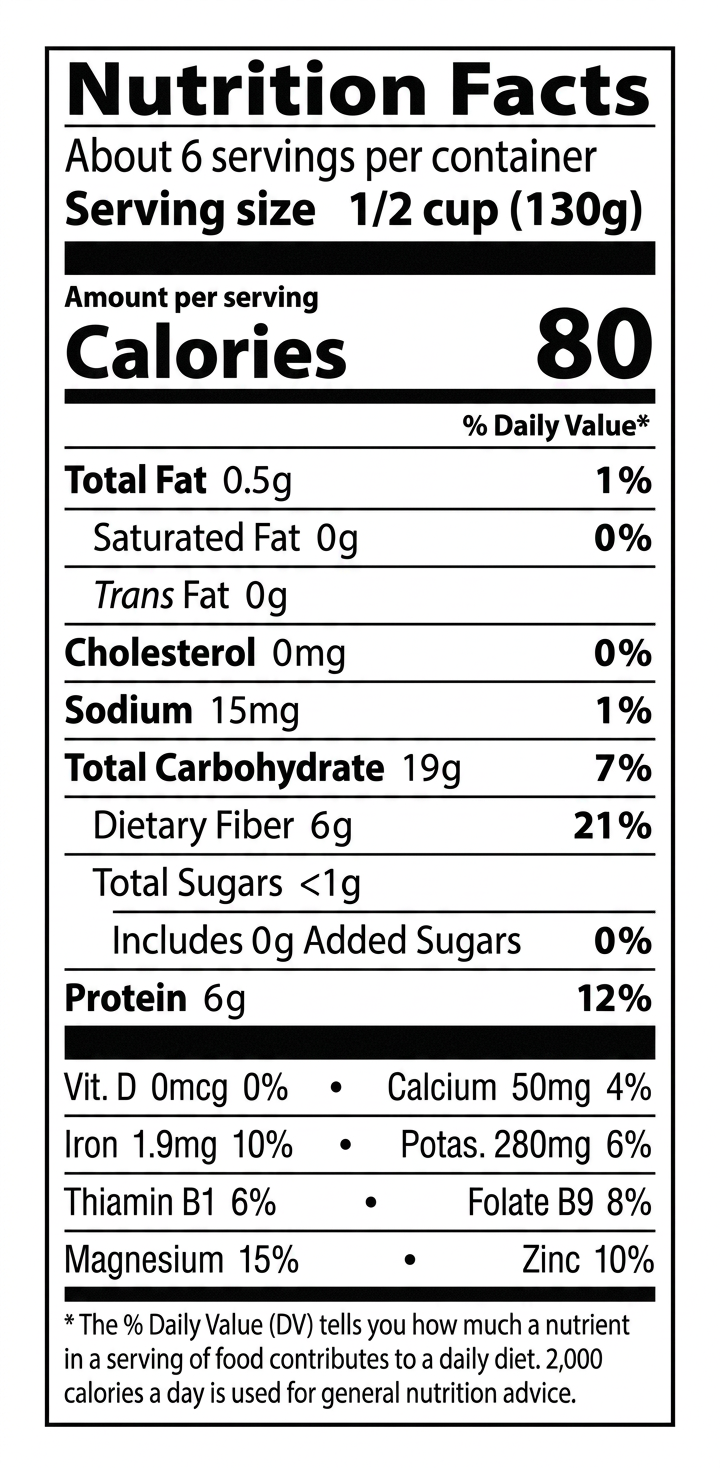
Here is an example of a food label. Specifically, you are looking at a standard Nutrition Facts Table for a common food item.
You can see, from top to bottom, the serving size, number of calories in the serving size, bolded macronutrients (Macros; i.e. Protein, Carbohydrate, Fat), bolded health awareness components such as Sodium and Cholesterol, breakdowns of the macros including types of fat or sugar vs fibre, and micronutrients at the bottom (vitamins and minerals).
Along the right hand side you will see percentages, these are called the “% Daily Value” (%DV).
Once you have familiarized yourself with the anatomy of a Nutrition Facts Table, you are ready to start analyzing what you are reading. Here is your step by step strategy for best understanding what the information on this label means:
-
Start with Serving Size
- Your critical first step. This is the amount of food the rest of the numbers are based on. Measurements are in common units (cups, tablespoons, number of pieces, fractions) along with metric units (grams, millilitres), etc.
- Serving sizes are based on reference points. A serving size is not an automatic recommendation for your portion size!!! And your portion size may or may not match the serving size.
- Eating more or less food than the listed serving size, means the nutrition facts in the rest of the table will change accordingly.
-
Review the Macros/Calories
- Check the raw number for Calories. Remember this is calories per serving.
- Look at the raw number for each Macro in grams.
- A simplified, general rule of thumb is that whichever Macro has the highest number, that is the predominant macro in that food.
- Note the nuance here because each macronutrient has a different amount of calories per gram… but more on that later.
-
Check the Macro Breakdowns
- Choose foods with little or no trans fats per serving.
- Choose foods with at least 2g of fibre (and ideally more) per serving.
-
Use %DV
- A tool to help you figure out whether the food has a little or a lot of a specific nutrient.
- 5% DV or less is a little; 15% DV or more is a lot.
- Especially helpful for sodium, sugar, saturated fats, and cholesterol. Prioritize foods with less than 15% DV of each of these!
- Consider choosing foods with more healthy nutrients such as fibre, vitamin A and C, iron, calcium, and potassium.
Imagine you are back in that grocery store, in the bread aisle, comparing two loaves with everything you just learned. This step by step guide is most helpful for exactly that: comparing similar food items and determining which are better for you and your health. Tailor these steps for whatever is best for you and your health goals.
Make sure you are comparing the same amount of food (serving size) between two products. Adjust the math accordingly as a first step during product comparisons, so you can accurately compare which food has more or less of something, whether calories, macros, or minerals. A couple more notes:
- Just because a food is lower calories per serving, does not automatically make it the healthiest choice.
- Just because one option has lower saturated fat, doesn’t mean it doesn’t have higher sugar or little to no protein.
- Just because sodium is low, doesn’t mean fibre will be sufficiently present.
I hope you take away that choosing a healthier option will not always be straightforward. That is okay. Foods may be high in protein and high in cholesterol. Or high in sodium and low in calories.
Here’s where chasing progress, not perfection applies. You don’t need to find the “perfect” food breakdown. You do need to understand what is in your food and know how to navigate this, so that you can make the best choices for yourself and your health.
I appreciate this can be difficult, confusing and time consuming at first. But making time to practice reading nutrition facts is important. And now you are ready with the knowledge and tools to do so.
I hope this helps you prioritize healthy food choices, proactively choose options that are better for you, and gain a better sense of what you are really putting into your body.
As always, chase progress, not perfection.
I believe in you,
Dr. Khimji
This Week’s Challenge
At least 5 nights this week, try to stop using screens at least 1 hour before bed.
[PS. This Week’s Challenge is a new-ish segment of the blog where I encourage you to join me to work on a small, new healthy behaviour during the week. They are intentionally designed to be tiny and reasonable, so you can do them during the busy-ness of life.]
The Bottom Line
How do you choose between two similar food items in the grocery store? Comparing calories, fibre, protein, price, and ingredients are all important, but getting the whole picture is critical. Having a method or system to follow consistently goes a long way. An excellent source of information is the Nutrition Facts Table on a food label. This shows you everything from serving size and calories to macronutrients, micronutrients, and % Daily Value (5% is a little; 15% is a lot). Always start with the serving size first because the rest of the table is based on this. Servings are not the same as portions! The highest of the 3 Macros is usually the predominant macro in that food item. Foods may be high in protein and high in cholesterol. Or high in sodium and low in calories. It will not be black and white. It will not always be straightforward. That is okay. Instead of getting hung up on finding a “perfect” food label, pay attention to what is in your food and how to navigate food labels. This helps you make the best decision for yourself and your health!