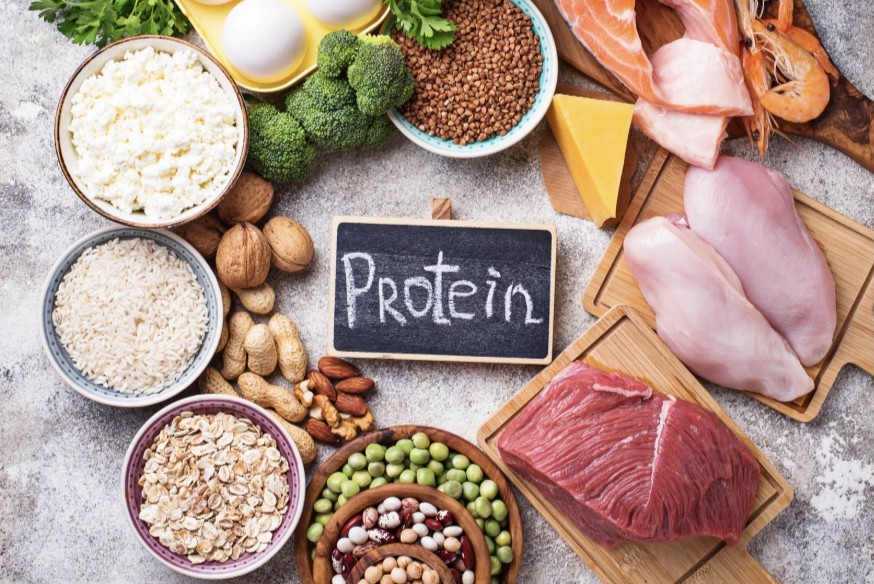
The other day while grocery shopping, I walked past a shelf with a row of bright pink packages just below my eye level. Each label: “PROTEIN CANDY”. Protein. Candy. You are reading that correctly. How did we get here? We eat food, not components of food. Yet somehow we keep moving further and further away from this; chasing macros and elixirs believing single interventions will solve all our problems. Now on the flipside, protein is important. It is an essential macronutrient for muscle and optimal body function. And you do need to consume enough on a daily basis. So, which is it? Read on to learn how both of these truths co-exist and how you can discover a practical approach to protein. One that you can actually build into your groceries, meals, and life!
(Short on time? Click here for The Bottom Line)
As shocked as I was to see the “Protein Candy” products, I suppose it shouldn’t have come as such a surprise. These days we see protein highlighted everywhere. What gets me the most is how misleading the front-of-package labeling is. Health claims and marketing phrases are commonly presented in eye-catching formats with no context. This creates significant confusion for all of us as we navigate the minefield of nutrition in 2026.
We are missing the forest for the trees. Think about the overall entire package of food you eat as you continue to improve your nutrition. I encourage you to always look at the back of the packaging when you are buying food, whatever it may be. Review both the ingredient list and the nutrition facts table (more on how to read and interpret this information coming soon). These are much more accurate than any front-of-package labels or claims.
A quick example. The front of cereal boxes and yogurt tubs, and many other food packages, nowadays advertise “High Protein” or some number of grams of protein. If you flip these products over and review the labels on the back, you might be surprised to learn the actual amount of protein and how it depends on serving sizes, which also vary by product! Also, remember to add context to the front-of-package claims you see. For instance, sure, a cereal box might say “high protein”, but that is relative to other cereals which are lower in protein. And either way, cereals are not protein rich sources of food.
This is precisely what I would like you to know. We will explore some great whole food protein sources that you can consume in order to get the protein you need, enhance your health, and feel less overwhelmed by all the marketing and advertising.
But first, what are protein rich sources of food? Defining this involves using percent daily value (% DV), weight of protein per serving size, and/or protein quality based on amino acid profile. The simplest approach for me is the middle option, where we look at serving sizes which provide at least 10g of protein or more ideally ~20-30g of protein.
Similar to your High-Fibre Grocery List, here are a few whole food sources of protein to include in your shopping and meal planning rotation:
Plant-Based Protein Sources:
(grams of protein per serving)
- Seitan (Vital Wheat Gluten, Cooked): 25g per ~⅔ cup
- Tofu (Extra-Firm, Cubed): 23g per ~1 cup
- Tempeh (Cooked): 24g per ~¾ cup
- Edamame (Shelled): 22g per ~1 cup
- Lentils (Cooked): 27g per ~1½ cup
Animal-Based Protein Sources:
(grams of protein per serving)
- Greek Yogurt (0% Fat, Plain): 23g per ~1 cup
- Chicken Breast (Cooked): 22g per ~½ cup
- Canned Tuna (Drained): 26g per ~⅔ cup
- Lean Ground Beef (Cooked): 26g per ~¾ cup
- Salmon (Cooked): 25g per ~¾ cup
You’ll notice that each of the above options provide about 20-30g of protein per serving. We aim for that target because it is equivalent to approximately one palm-sized portion of protein. More on this later, but in a nutshell, look at the palm of your hand, and the thickness of your palm (directly below your little finger). Any of the protein sources listed above, whose serving size fits in your palm, will give you about 20-30g of protein. This makes for a more simple way to estimate whether you are getting enough protein everyday or not.
How much protein do we need everyday? Here are the targets. When making nutrition changes such as these, start by determining your baseline (i.e. how much protein you eat on average per day right now). Then look at the gap between this and your target, and make a plan to work towards filling the gap in a progressive, sustainable way.
You may have noticed that the above lists only include whole foods for protein sources. Consuming whole foods is important for your health. The above list is not exhaustive and you can find protein from a variety of other foods such as:
- Plant-based: nuts, seeds, all kinds of beans, peas, other types of lentils, chickpeas, fortified soy beverages and other soy products.
- Animal-based: eggs, other lean meats and fish, and other low fat dairy products.
There is also a role for protein supplements such as powders or shakes, of which there are all sorts of types, but again we are focusing on whole foods sources right now.
Finally, a note on plant proteins vs animal proteins. Plant-based proteins are pre-packaged with fibre which means more disease fighting benefits for you. They also include all 9 essential amino acids, particularly when consumed in combination (i.e. rice and beans). Animal-based proteins are often pre-packaged with saturated fat, which has more disease causing effects. Again, this comes back to keeping in mind that we eat whole forms of food, not macronutrients in isolation.
Make small changes, build on these over time, and watch your health transform for the better.
As always, remember to chase progress, not perfection.
I believe in you,
Dr. Khimji
The Bottom Line
Protein is everywhere. But we still struggle to eat enough. We eat food, not nutrients in isolation. But we still need those nutrients, including protein. Never rely on the front-of-package claims and marketing. Always look at the ingredient list and nutrition label on the back of packages for more accurate data. Aim for 20-30g of protein per serving. How many servings you need per day depends on your daily protein target. Scroll up to see links for the targets and examples of protein rich sources of whole foods that you can eat. Remember to think about the entire, overall package of food you are eating, not just a nutrient in isolation. Plant proteins are pre-packaged with fibre, which boosts your health. Animal proteins often come with saturated fat, which harms your health. Make small changes with gradual progress over time and watch your health transform for the better.